
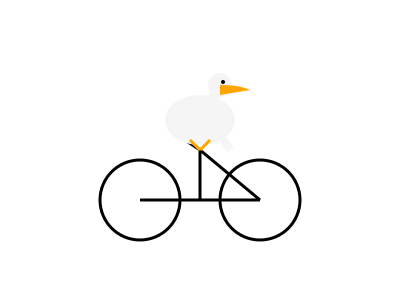
Initial 16 models
Most models drew only a bird or geometric shapes
Models could usually generate SVG and approximate birds or wheels, but they could not assemble a coherent bicycle-riding scene.
 Pelican Test
LLM SVG capability evolution
From abstract shapes to a pedaling pelican, explore 30 real test milestones in chronological order.
Choose a year to see how models gradually solved objects, structure, contact, and motion.
Initial 16 models
Models could usually generate SVG and approximate birds or wheels, but they could not assemble a coherent bicycle-riding scene.
QwQ 32B Preview
A longer reasoning process still produced an abstract bird. This early sample showed that more reasoning tokens do not guarantee better spatial composition.
Gemini exp-1206
The subject, two wheels, frame, and ground all appear together. The image is still imprecise, but it moves from recognizing objects to composing a scene.
DeepSeek V3
The pelican, wheels, and frame now share one image, but they look stacked together and their contact relationships remain weak.
DeepSeek R1
The pelican and bicycle are easier to recognize and more detailed, but the bird, handlebars, and pedals still lack believable connections.
Claude 3.7 Sonnet
Both standard and thinking modes drew a complete subject and bicycle elements, but parts were still duplicated, misaligned, or stacked.
Gemini 2.5 Pro
The question shifted from whether there was a bicycle to whether the frame made sense and the feet truly met the pedals.
Claude Sonnet 4 / Opus 4
Sonnet 4 produced the more complete bicycle, while Opus 4 omitted wheel spokes. Both completed the scene, but the flagship did not clearly win this single sample.
Gemini 2.5 Pro Preview 06-05
The red frame, two wheels, and handlebars connect to one another, and the pelican's pose looks more like riding.
Claude Opus 4.1
The line drawing clarifies the beak and pedal relationship, but the frame is still implausible, showing that the point release did not reliably solve spatial structure.
GPT-5 family
The frame, spokes, pedals, leg placement, and overall proportions all improved. Smaller models could also complete the scene, though detail did not improve monotonically with model size.
Claude Sonnet 4.5
Both results show a recognizable pelican and bicycle, but the component connections remain unreliable. Thinking provided no consistent structural advantage in this single sample.
Claude Haiku 4.5
A rounded bird, two wheels, and ground appear together. The subject looks like a generic bird, but the lower-cost tier crossed the complete-composition threshold.
Claude Opus 4.5
With the original prompt, the pelican orientation and frame still had problems. Adding breeding plumage and throat-pouch requirements improved both, so the result is marked as mixed criteria.
GPT-5.2
The base prompt already produces a complete result. The enhanced prompt adds species, plumage, and throat-pouch requirements, so the two should not be ranked directly.
Claude Opus 4.6
The beak, throat pouch, and feathers now look convincingly pelican-like. The bicycle mostly works, though its frame geometry remains slightly misaligned.
Claude Sonnet 4.6
Both attempts gave the pelican a top hat. The shown sample adds a stray line between the beak halves and bends the frame, proving completeness is not the same as correct relationships.
Gemini 3.1 Pro
The original prompt supports longitudinal comparison, while the enhanced prompt tests plumage, throat pouch, pose, and scene detail.
GPT-5.4 family
Models and reasoning levels from one family form a comparison matrix. More reasoning often helps, but does not guarantee a better single image.
Claude Opus 4.7
Both default and max-thinking results show recognizable pelicans, but their frames fail in different ways. More reasoning did not solve the structural problem in this test.
Qwen 3.6 27B
A roughly 17GB local model drew a complete frame, spokes, handlebars, and pedaling pose. Progress was no longer limited to large cloud models.
Claude Opus 4.8
Low, medium, and high looked more like ducks or herons. Pelican features became reliable at xhigh, while max produced the most complete bird and bicycle at the highest output cost.
Claude Fable 5
With one fixed prompt, five effort levels formed a clear gradient in shape, structure, and output cost. High used fewer tokens than medium, showing that reasoning budget is not a linear dial.
GLM 5.2
The scene structure is already complete and can be animated. The new challenge is keeping the feet on the pedals as the wheels turn.
Claude Sonnet 5
The wheels, frame, and grip on the handlebars are coherent, but the subject looks more like a white goose. Species recognition can still fail independently after structure matures.
GPT-5.6 family
Luna, Terra, Sol, and multiple reasoning levels form a 3×3 grid showing the combined effects of model tier, reasoning budget, and sampling.
Kimi K3
The scene is quite coherent, but the test cannot represent differences in agent capabilities or tool use, and now faces over-reasoning and cost issues.
Claude Opus 5
The first version reused wheels with SVG use elements. Simon recorded them as missing, though they render in modern browsers here. The second used explicit wheels and a steadier composition.
Qwen 3.8 27B
Xhigh reasoning produced a structurally complete result, while disabling reasoning made the composition much looser, exposing the tradeoff among quality, wait time, and local resources.
Undisclosed new model
The original post did not name the model, and the discussion suggested it may have seen the test before. Only the result is shown here, without ranking it.
It reveals the direction of change, but does not replace systematic evaluation. These rules keep different tasks from becoming a false leaderboard.
The main thread always uses “Generate an SVG of a pelican riding a bicycle.”
Adding requirements for species, plumage, or background changes the task, so the results should not be ranked directly.
Animated SVG must also handle time and motion, making it a different challenge from static output.
Samples with a result but no model or run information remain visible, but do not inform capability judgments.
No traceable original image from the same prompt has been found for Claude 3 Sonnet, Claude 3.5 Haiku, or Mythos 5, so no placeholder milestones are added.